
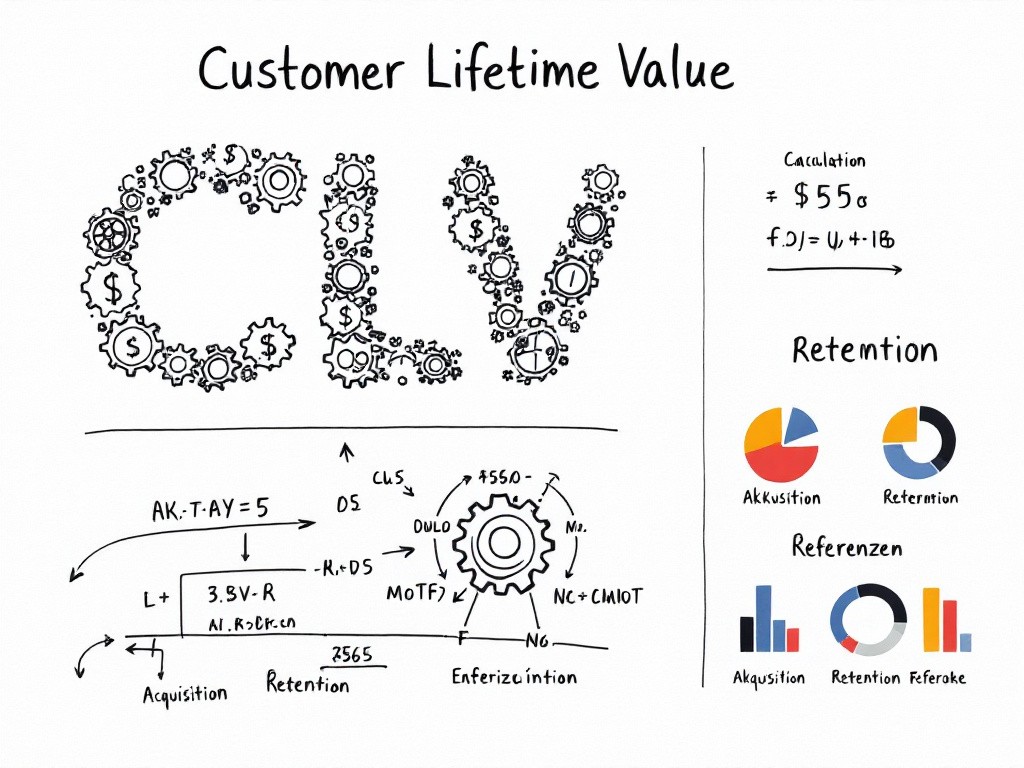
Customer Lifetime Value (CLV): Meaning, Calculation & Strategies

Customer Lifetime Value (CLV): Meaning, Calculation & Strategies

Customer Lifetime Value (CLV): Meaning, Calculation & Strategies

Customer Lifetime Value (CLV) is a key figure in marketing that measures the total financial value of a customer over the entire business relationship. Companies use CLV to use their resources efficiently and to operate profitably in the long term.

Customer Lifetime Value (CLV) is a key figure in marketing that measures the total financial value of a customer over the entire business relationship. Companies use CLV to use their resources efficiently and to operate profitably in the long term.

Customer Lifetime Value (CLV) is a key figure in marketing that measures the total financial value of a customer over the entire business relationship. Companies use CLV to use their resources efficiently and to operate profitably in the long term.

What is Customer Lifetime Value (CLV)?

Customer lifetime value (CLV) is a key figure in marketing and sales. It measures the total financial value of a customer over the entire duration of the business relationship. Companies use CLV to assess customer profitability and develop targeted strategies for customer retention and acquisition.

Calculation of CLV

A simple formula for calculating CLV is:

clv=average order value×purchase frequency×customer lifetimeCLV =\ text {average order value}\ times\ text {purchase frequency}\ times\ text {customer lifetime}

Expanded models also take into account costs such as marketing spending, customer service, and discounts to enable an even more accurate assessment of customer profitability.

Why is CLV important?

The CLV helps companies to use their resources efficiently and to operate profitably in the long term. An overview of the most important benefits:

  • Better budget distribution — Marketing spending can be targeted at valuable customers.

  • Focus on long-term relationships — Loyalty and repeat purchases are often more profitable than one-time transactions.

  • Optimizing the pricing and product strategy — Companies can take targeted measures to increase sales.

  • Improving customer loyalty — A high CLV means greater customer loyalty and less churn.

Factors that influence CLV

Several factors determine how high a customer's CLV is:

  • customer satisfaction — Happy customers buy more often and stay longer

  • Customer loyalty programs — Discounts and bonuses encourage repeat purchases.

  • Product quality — High-quality products increase customer loyalty.

  • Effective marketing — Relevant and personalized campaigns increase CLV

Strategies to increase CLV

Companies can actively increase CLV by taking the following measures:

  • Personalized offers — Reach out to customers with individual, relevant recommendations.

  • Excellent customer service — Quick and helpful support promotes loyalty.

  • Cross- and up-selling — offer additional products or upgrades to increase revenue per customer

  • Measure and improve customer satisfaction — Regular feedback helps with optimization.

conclusion

Customer lifetime value is an essential indicator for companies that want to work profitably in the long term. Through targeted customer loyalty measures, CLV can be increased, which has a direct effect on the company's success. Companies should therefore continuously adjust their strategies to maximize the value of each customer.

Read next article

Read next article

Read next article

SWOT Analysis for CRM Systems: A Comprehensive Look

In the dynamic world of sales and customer relationship management, a well-implemented **CRM-System** can be a game-changer. To understand the full spectrum of CRM-Software, a SWOT analysis is a useful tool. SWOT stands for Strengths, Weaknesses, Opportunities, and Threats, and it helps to evaluate the potential and pitfalls of CRM-Systems.

SWOT Analysis for CRM Systems: A Comprehensive Look

In the dynamic world of sales and customer relationship management, a well-implemented **CRM-System** can be a game-changer. To understand the full spectrum of CRM-Software, a SWOT analysis is a useful tool. SWOT stands for Strengths, Weaknesses, Opportunities, and Threats, and it helps to evaluate the potential and pitfalls of CRM-Systems.

SWOT Analysis for CRM Systems: A Comprehensive Look

In the dynamic world of sales and customer relationship management, a well-implemented **CRM-System** can be a game-changer. To understand the full spectrum of CRM-Software, a SWOT analysis is a useful tool. SWOT stands for Strengths, Weaknesses, Opportunities, and Threats, and it helps to evaluate the potential and pitfalls of CRM-Systems.

SWOT Analysis for CRM Systems: A Comprehensive Look

In the dynamic world of sales and customer relationship management, a well-implemented **CRM-System** can be a game-changer. To understand the full spectrum of CRM-Software, a SWOT analysis is a useful tool. SWOT stands for Strengths, Weaknesses, Opportunities, and Threats, and it helps to evaluate the potential and pitfalls of CRM-Systems.

Empower your business.

English

© Copyright 2025 by Rowisoft GmbH. All rights reserved.

Various trademarks held by their respective owners. Mister James and Rowisoft are trademarks of the Rowisoft GmbH.

Empower your business.

English

© Copyright 2025 by Rowisoft GmbH. All rights reserved.

Various trademarks held by their respective owners. Mister James and Rowisoft are trademarks of the Rowisoft GmbH.

Empower your business.

English

© Copyright 2025 by Rowisoft GmbH. All rights reserved.

Various trademarks held by their respective owners. Mister James and Rowisoft are trademarks of the Rowisoft GmbH.

Empower your business.

English

© Copyright 2025 by Rowisoft GmbH. All rights reserved.

Various trademarks held by their respective owners. Mister James and Rowisoft are trademarks of the Rowisoft GmbH.